WhiteCoat · Healthcare AI · 2025–2026
Every teleconsult starts with the doctor asking the basics — while the patient just spent their whole queue wait doing nothing. Cody is WhiteCoat’s AI-assisted triage nurse: it chats with patients while they wait, gathers symptoms conversationally, assesses whether a teleconsult is suitable, and hands the doctor a summary before the call begins. It never diagnoses, never gives medical advice, and never blocks anyone from seeing a doctor.
Product designer, end-to-end triage UX — from consent and capability disclosure to the conversation, its outcomes, and every exit. The final design is complete and now under company review — not yet shipped.
WhiteCoat · Singapore
Role
Product Designer
Surface
Patient App · Conversational AI
Timeline
2025–2026 · Phase 1
Team
PM · AI/ML Eng · Clinical Advisor · Eng
Status
Final design · in review, not yet shipped

The entry — Cody introduces itself the moment the app opens: three steps in plain language, “Start GP Journey”, and a genuine “Maybe Later”.

The happy path — the fever conversation reaches a green Suitable status without the patient ever leaving the queue.

The hard case — chest pain flagged Unsuitable: an honest explanation and four open doors, from “Call 995” to continuing anyway. A recommendation, never a verdict.
Cold start
Every consult begins with the same questions
Doctors spend the first minutes of every video call collecting basics — symptoms, onset, severity — that the patient could have shared before the call started.
Too late
Unsuitable cases surface mid-consult
A patient with severe chest pain can sit through a queue and start a video call before anyone realises they need an A&E, not a webcam. The discovery happens at the most expensive possible moment.
Wasted
Queue time is dead time
Patients wait staring at a queue position. All of that time — minutes per consult, across every consult — was doing nothing for the patient or the doctor.
The brief, in one sentence: use the wait — not another gate — to understand the patient, so the doctor starts prepared and unsuitable cases surface before the consultation begins.
Goals for Phase 1
Turn queue time into preparation time — symptoms gathered conversationally while the patient waits
Assess teleconsult suitability early, with a clear escalation path for emergencies
Keep the AI in a supporting role: no diagnosis, no medical advice, and no power to block care
Earn the right to use AI — explicit consent and honest capability disclosure before the first message
The instinctive place for triage is at the gate: question the patient before they’re allowed to book. An earlier iteration explored exactly that — a structured five-question form between booking and the queue, with graduated outcome tiers. It worked, but it added friction to every single consult and made the AI feel like a gatekeeper.
The design that stuck moves triage into the queue. Patients book exactly as before — nothing new stands between them and a doctor. While they wait, Cody offers a conversation. The framing flips from “prove you deserve a consult” to “help your doctor prepare”. Same clinical signal, zero added journey time, and the AI becomes a service instead of a checkpoint.
✕
Iteration — triage at the gate
A structured form before the queue
Five fixed questions with chips and a red-flag checklist, routing patients to one of five outcome tiers before booking. Deterministic and auditable — but every patient paid a friction tax up front, and a “not suitable” verdict felt like a locked door.
✓
Direction — Cody, in the queue
A conversation while you wait
Free-text chat with one adaptive follow-up at a time, running in parallel with the wait. Suitability is assessed without ever gating the consult, and the transcript becomes the doctor’s preparation — the queue finally does something useful.
From the working file: the iteration we killed.

The gate, as it was actually designed
A structured questionnaire with fixed questions and answer chips, standing between the patient and the queue. Deterministic, auditable — and a toll on every single consult.
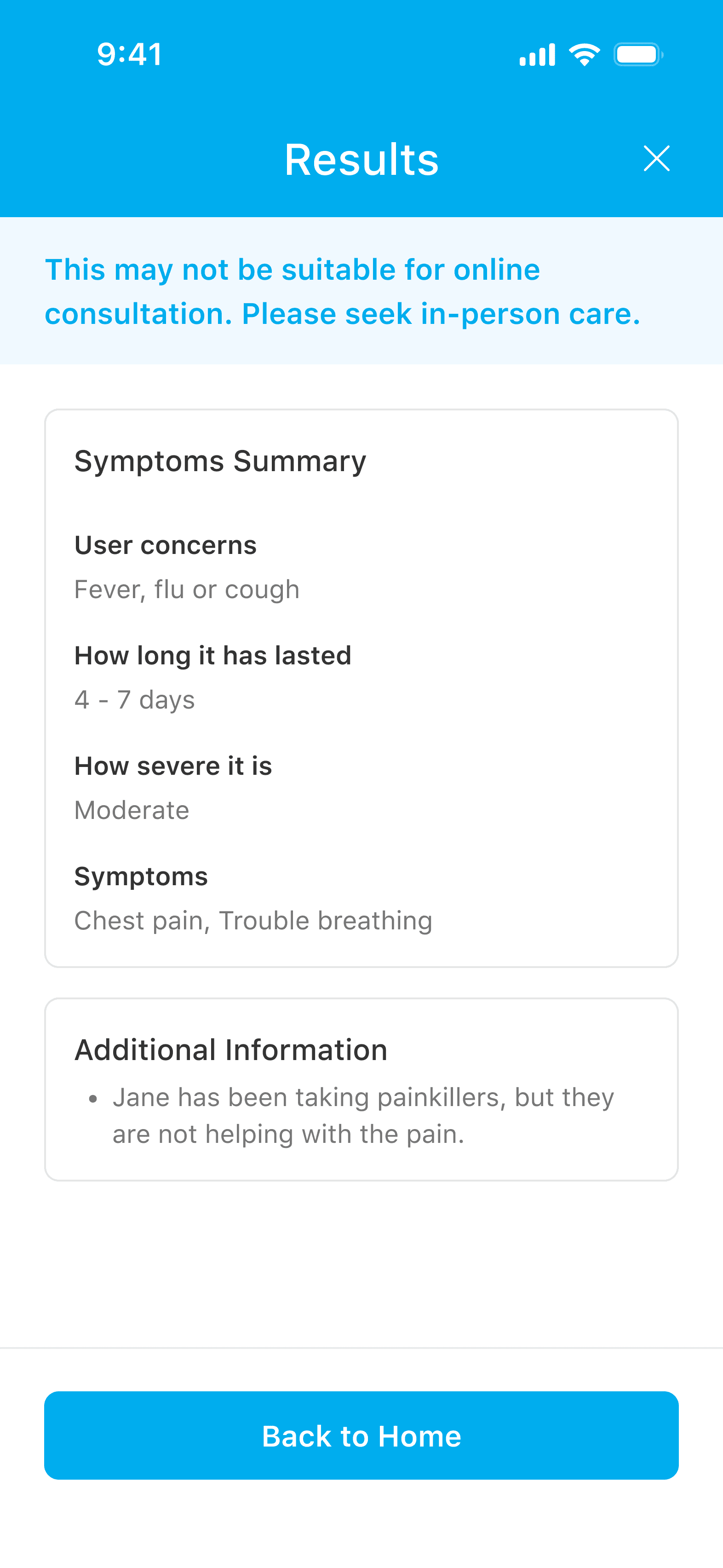
The screen that killed the direction
“This may not be suitable for online consultation. Please seek in-person care.” The only action: Back to Home. A verdict and a closed door — compare the shipped recommendation panel, where every option stays open.
A triage AI has two ways to fail, and they are not equal. Most of the design’s structure exists because of this asymmetry — it’s the analysis every screen answers to.
False Unsuitable
Cody wrongly advises in-person care
The cost is an unnecessary clinic trip — annoying, not dangerous. And because a recommendation is never a verdict, the patient can simply continue with the teleconsult anyway: the mitigation is that nothing was ever gated.
False Suitable
Cody wrongly clears a serious case
The dangerous direction — and the reason the mitigation is architectural, not conversational. Triage never replaces the doctor: every patient still reaches one, with the transcript attached, so a wrong “suitable” is caught by the clinician minutes later. The 995 footer and the amber emergency warning persist on every screen regardless of status.
The system’s safety doesn’t depend on the model being right. It depends on the model never being the last word.
These demands crossed the aisle. When an engineering colleague ran a formal evaluation of agentic platforms for Cody, the selection criteria read like the design’s trust requirements restated: deterministic, auditable conversation state; human-in-the-loop gates; repeatable evaluation of emergency detection; a clinician-facing handoff summary. When design principles become engineering selection criteria, the trust architecture is real — not decoration on top of a chatbot.
Part 1
Before Cody asks a single question, it earns the right to ask: explicit consent, declared limits, and a genuine way to say no. Trust is designed before the chat, not during it.
Every decision was made through a trust lens first — the stakes of a wrong recommendation are real. Four principles governed the whole experience.
Consent
Earn the conversation before starting it
Before the first message, patients see exactly what they’re agreeing to in three explicit bullets: answers processed by AI to check suitability, the chat and a short summary shared with their doctor, and secure storage kept only for this consult. “Agree & Continue” or “Not Now” — consent is a real choice, not a wall of terms.
Honesty
Lead with what the AI cannot do
“Learn more about Cody” expands right on the consent screen, pairing capabilities with a red-lettered cannot-do list: cannot diagnose, cannot replace a doctor, cannot give medical advice, cannot decide your care. An amber note holds the hardest line: “If it’s severe or life-threatening, call 995.”
Autonomy
The AI can recommend everything and block nothing
Even when Cody flags chest pain as unsuitable, the recommendation panel keeps every option open: Call 995, continue with the teleconsult, leave the queue to find a nearby clinic, or keep chatting. Triage is skippable and interruptible. The AI advises; it never decides.
Hierarchy
The doctor always outranks the bot
The moment the doctor is ready, Cody stands down: “We’ll stop Cody and take you to your consultation now. Your triage summary has been shared with your doctor.” Every chat screen carries the same footer: recorded for clinical safety, do not use in emergencies.

A nurse, not a wizard
“Cody is Here While You Wait” sets the role before the first message: support before the doctor, never instead of one.

Consent before conversation
Processed by AI, shared with your doctor, stored securely — and the amber line that holds hardest: “If it’s severe or life-threatening, call 995.” Then “Agree & Continue”, or “Not Now”.

The capability sheet
“What AI Triage Can Do” beside a red “What AI Triage Cannot Do”: no diagnosis, no medical advice, no care decisions, no replacing a doctor.
Part 2
From the queue screen to the doctor’s interrupt: the happy path, the hard cases, and every exit — designed so the patient is always in charge and never lost.
Nothing about booking changes. Cody appears after the patient is already in the queue — introduced on the home screen, consented before the first message, and always one tap from being dismissed.
1
Patient
Books a GP consult as usual
Nothing new stands between the patient and a doctor — booking is untouched.
2
Patient
Joins the queue
The queue screen offers Cody as an option — “Start our AI triage anytime” — never a requirement.
3
Cody
Asks for consent, declares its limits
Three consent bullets with the expandable can-do / cannot-do list — “Agree & Continue”, or “Not Now”.
4
Cody
Runs the conversation
Free-text chat, one adaptive follow-up at a time — onset, severity, associated symptoms, medications — with status and queue position always visible.
5
Cody
Reaches a status: Suitable or Unsuitable
Both outcomes leave every option open — the AI advises, it never decides.
6
Emergency path
Escalation is one tap away
For emergencies: Call 995 Now. For cases better served in person: a GP clinics map with addresses, hours, and directions.
7
Doctor
Doctor ready — Cody stands down
“Your Doctor is Ready. Your triage summary has been shared with your doctor.” Start Consult — and the call begins prepared.
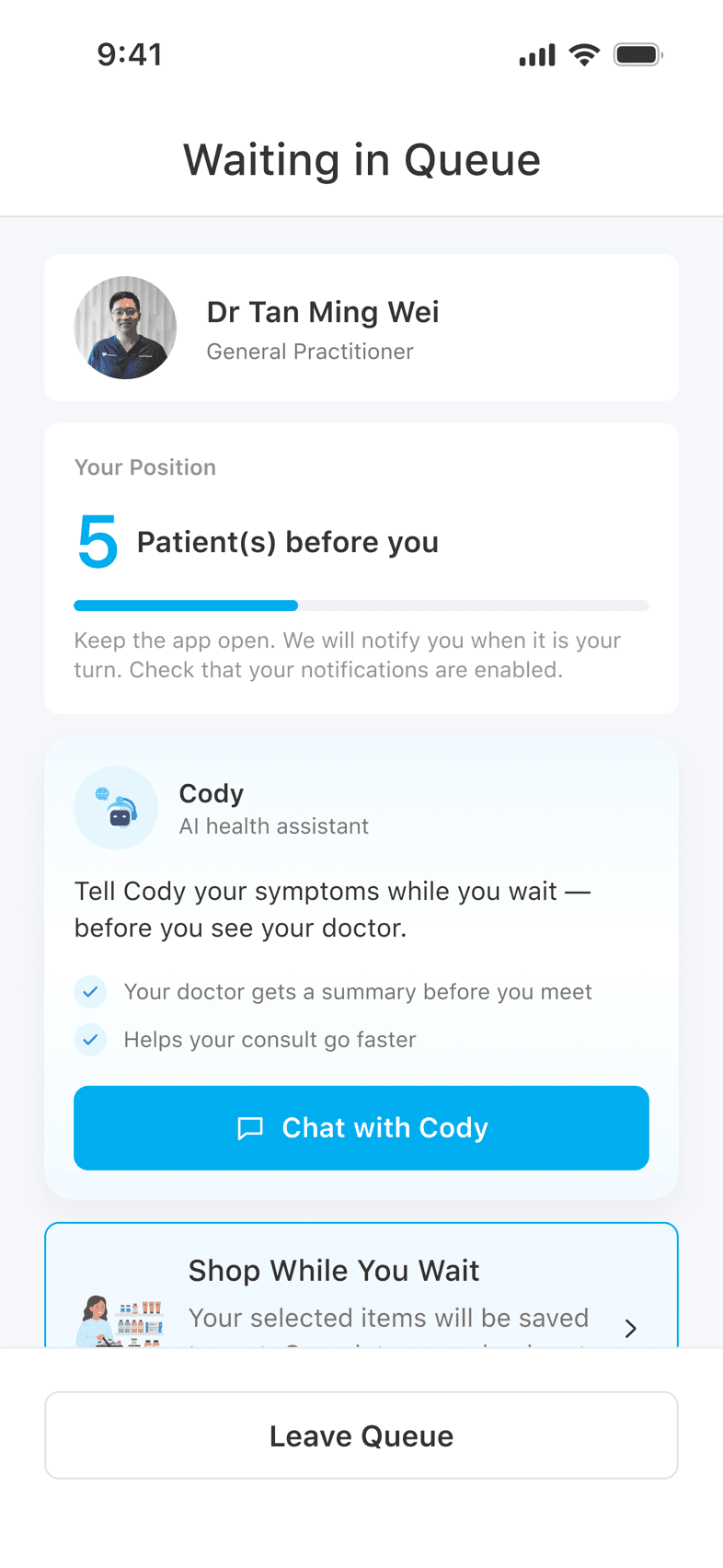
The wait becomes a lobby
The queue screen now works for the patient: the doctor’s card, a live position — and Cody’s offer in the middle: “Tell Cody your symptoms while you wait — before you see your doctor.” One tap to chat, “Leave Queue” one tap below; the consult happens either way.
A recommendation, never a verdict — whichever way the status lands, the patient keeps every option open.

Suitable — the queue spot is protected
Green status, gentle copy (“you might be suitable for a teleconsult”), and a recommendation panel that protects the patient’s place: “Continue with Teleconsult — you keep your spot in the queue”, or “Continue Chat” to add more for the doctor.
Unsuitable — four open doors
Chest pain gets an honest explanation and four open doors: Call 995, continue with the teleconsult anyway, leave the queue to find a nearby clinic, or keep chatting. A recommendation, never a verdict.
The handoff, and the exit that still cares
The conversation’s whole purpose lands in the handoff — and even the patients Cody sends elsewhere end somewhere useful.

The interrupt that always wins
“Your Doctor is Ready. We’ll stop Cody and take you to your consultation now. Your triage summary has been shared with your doctor.” The conversation’s whole purpose lands in this handoff.

The exit that still cares
Unsuitable cases that leave the queue aren’t abandoned — a clinics list over the map with addresses, hours, and directions turns “not here” into “here’s where”.
A finalised design — honest about what’s next.
The design is now final and sits with the company for review — approval to build and ship is pending. I’d rather publish nothing than publish a guess, so here is exactly where the work stands.
✓ Designed
The full Cody loop
Introduction, consent and capability disclosure, the adaptive chat with live status and queue position, Suitable and Unsuitable outcomes, and the doctor-ready handoff with the triage summary shared.
✓ Designed
The exits and emergencies
One-tap Call 995, the GP clinics map for unsuitable cases leaving the queue, leave-and-resume chat with progress preserved, and the doctor-ready interrupt that always wins over the bot.
→ Still to design
The doctor’s side of the handoff
The triage summary view in the Doctor Portal — how Cody’s conversation lands on the clinician’s screen — is the biggest open piece. The handoff promise is designed; its destination isn’t final yet.
→ Still to design
AI failure states & edge cases
Error and fallback states (misunderstood answers, no response, service down) and localisation beyond Singapore. The final design consolidated what were once four iterations of the queue screen and six of the clinics list.
What I’d measure first
No numbers are claimed on this page. These are the four instruments I’d read when Phase 1 meets real patients — each one tests a specific design bet.
Opt-in rate
Do queueing patients choose to start Cody?
The offer is deliberately optional — a low rate doesn’t mean patients failed, it means the queue card isn’t earning attention.
Completion to status
Do conversations reach a status before the doctor is ready?
Conversations that die mid-way point to question fatigue in the adaptive flow.
Pre-consult catch rate
Do unsuitable cases surface before the call, not during it?
This is the metric the entire design exists for — the “too late” problem, measured directly.
Handover usefulness
Do doctors actually open and use Cody’s summary?
The whole loop is only as valuable as its landing — this is the number that would justify designing the doctor-portal view next.
Where the AI sits matters more than what it asks
The same triage questions felt like a gate before booking and like a service inside the queue. Moving Cody into the wait — zero added journey time, framed as helping your doctor — changed the product more than any question redesign did.
Declared limits are a trust feature
Consent bullets and a red “what AI triage cannot do” list feel like legal furniture, but they’re the opposite: showing patients exactly where the AI stops is what makes its recommendations credible. Trust is built at the boundaries.
In healthcare AI, advice must never become authority
An earlier iteration removed the consult button for flagged patients — safe on paper, but it made the AI a door. Cody recommends 995 for chest pain yet keeps every option open, and stands down the instant the doctor is ready. The AI advises; humans decide.